
The 30-year fixed sits at 6.67% as of the middle of August 2026. Back in early 2015, buyers were nervous that rates might climb from the high 3s all the way to 5%. Read that again. We'd take a 5% mortgage in a heartbeat today.
So the real question isn't whether rates are high. They are, by the standard of the last decade. The question is where they go from here, and whether that should change how you buy a shore house. Here's what the numbers actually say, without the hype you'll get from a headline.
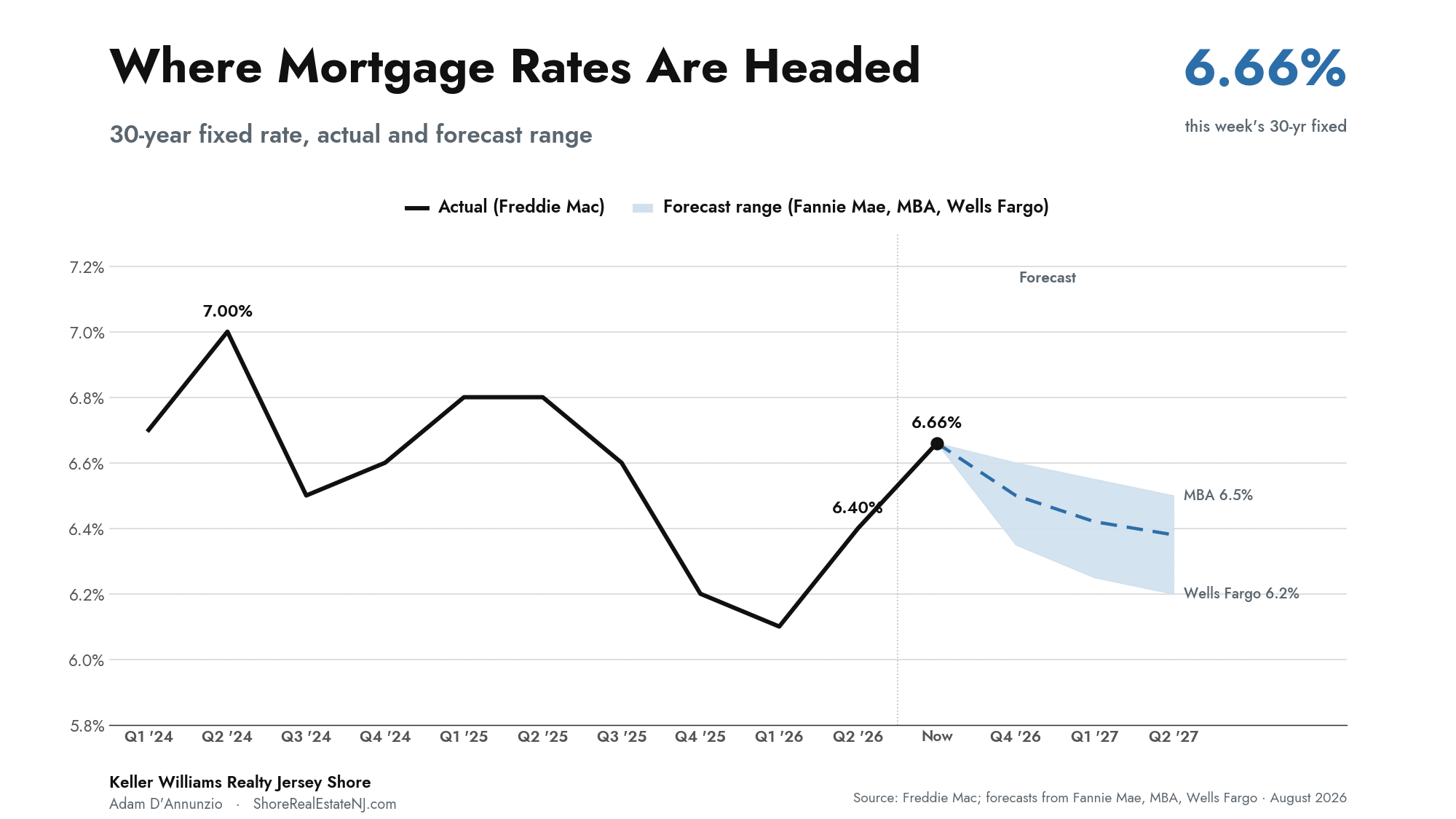
Where are mortgage rates right now?
As of Freddie Mac's August 13, 2026 survey, the 30-year fixed averages 6.67% and the 15-year fixed averages 5.96%. Rates have been stuck in a narrow band in the high 6s for most of the year. They aren't spiking, and they aren't falling off a cliff. They're grinding sideways.
Don't take my word for the number. You can track the 30-year and 15-year yourself, updated automatically.
For a market like ours, that number matters less than most people assume, and I'll get to why. But it's the anchor everything else hangs on, so start there.
Where are mortgage rates headed in 2026 and 2027?
Every major forecaster is now singing roughly the same tune. Rates ease a little from here, but nobody serious is calling for a return to the 3s or 4s. The disagreement is measured in tenths of a percent, not full points.
Where the forecasters land
30-year fixed, average projections for the periods shown
Today
6.67%
Aug 2026, actual
Late 2026
~6.4%
Fannie Mae / MBA
2027
6.0–6.4%
Fannie Mae / MBA range
Fannie Mae leans lower, toward the high 5s to low 6s by 2027. The Mortgage Bankers Association holds firmer in the mid 6s. Forecasts get revised every month, so treat these as direction, not a promise.
Notice how close those bars are to where we already are. The optimistic case gets you into the low 6s. The pessimistic case is basically today. If your whole plan hinges on rates dropping a full point, the people who model this for a living are telling you not to count on it.
Why haven't mortgage rates come down yet?
The Federal Reserve paused its rate cuts back in September 2025 and has held steady through the summer of 2026. The Fed doesn't set mortgage rates directly. What it does is shape the environment, and a Fed that's parked on the sidelines keeps a floor under borrowing costs.
Mortgage rates track the 10-year Treasury and the bond market's read on inflation more than any single Fed announcement. As long as inflation stays sticky and the bond market stays cautious, mortgage rates stay where they are. That's the honest answer. Not a conspiracy, just math and patience.
What does this mean if you're buying a shore house?
Here's where the shore market breaks from the national story. A big share of what trades in Ocean City, Avalon, Stone Harbor, Sea Isle, and the rest of the barrier islands is second homes and vacation properties. A lot of those buyers pay cash or put down enough that the mortgage rate is a rounding error, not the deal-breaker it is for a first-time buyer stretching to their limit.
If you're financing, the rate obviously affects your payment. But the thing that actually moves your net cost at the shore is the purchase price and the inventory you're choosing from, not a quarter-point swing in the 30-year. You can refinance a rate. You can't go back and buy the bayfront that sold last spring.
And rates are refinanceable by design. You lock the house at today's price, and if the low-6s or high-5s show up in 2027 the way the forecasters expect, you refinance into them. You marry the house. The rate is a rental.
Should you wait for rates to drop before buying at the shore?
Run the math instead of the emotion. The best-case forecast saves you roughly half a point over the next year or two. On a shore property, a half point is real money, but it's small next to what waterfront and near-beach inventory has been doing on price when demand holds and supply stays tight.
Waiting only wins if prices fall by more than you save on the rate, and if the house you want is still sitting there when you come back. At the shore, the best inventory doesn't wait. The trophy properties get picked off in every rate environment because the buyers at that level aren't rate-shopping, they're house-shopping.
None of this means rush. It means decide based on the property and the price, and treat the rate as a variable you can fix later.
Common questions about mortgage rates and the shore market
Will mortgage rates drop below 6% in 2026?
Probably not on the 30-year fixed. The forecasts that lean lowest have Fannie Mae seeing the high 5s creeping in around 2027, not 2026. For most of 2026, plan on the low-to-mid 6s.
Are mortgage rates for a second home higher than a primary residence?
Usually a bit higher, yes. Lenders price second homes and investment properties with a small premium over a primary residence, and the down payment expectations are higher too. Talk to a lender early so you're modeling the right number, not the teaser rate you see advertised.
Does the mortgage rate even matter if I'm paying cash?
Not for your financing, no. But it still matters for the market around you. Rates shape how many financed buyers you're competing with and how motivated sellers are, so they move the pricing environment you're buying into even when you're writing a check.
Is it smarter to buy now and refinance later?
For a lot of shore buyers, yes. You secure the property at today's price and today's inventory, then refinance if rates ease the way the forecasters suggest. The risk in waiting isn't the rate, it's the house you wanted trading to someone else.
What credit score do I need for the best rate?
Lenders reserve their best pricing for scores in the mid-700s and up, with the sharpest tiers usually starting around 740 to 760. A stronger score and a larger down payment both pull your rate down, sometimes by more than waiting on the market ever would.
The bottom line
Rates are in the high 6s and the smart money says they drift toward the low 6s, maybe the high 5s by 2027. No cliff, no miracle. If you're buying a shore house, that's not a reason to wait. It's a reason to buy the right property at the right price and keep the rate as something you can improve later.
Let's talk about your buy or sell at the shore, rate environment and all.